
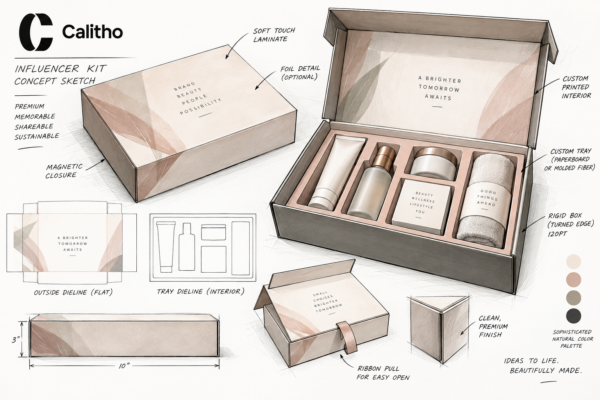
Artificial intelligence can create an impressive packaging concept in seconds. Ask for a luxury beauty box with a dramatic product reveal and sustainable materials, and generative AI can produce something that looks remarkably convincing.
But there’s a bigger question behind that beautiful rendering:
Can it actually be manufactured and at a cost that makes sense?
AI is already gaining ground in the packaging industry. A 2025 McKinsey survey of 110 senior packaging-company leaders in the United States and Europe found that 82% had launched, were developing or were considering generative AI solutions within their function, up from 30% in 2024.
The trend extends across manufacturing. Deloitte’s 2025 Smart Manufacturing Survey of 600 executives found that 24% had deployed generative AI at the facility or network level, while another 38% were piloting it.
The technology is moving quickly. But generating an idea and engineering a physical product are still very different things.
A Rendering Is Not a Dieline
AI is an exciting tool for exploring packaging ideas, shapes, colors, finishes and opening experiences. It can help brands visualize concepts faster and push creative thinking in new directions.
Manufacturing, however, requires much more than an image.
A production-ready packaging dieline must account for dimensions, cut and score lines, folds, tabs, glue areas, tolerances, material thickness and assembly time. Paperboard and corrugated materials also have physical properties that influence how a package scores, folds, glues, closes and performs.
For custom packaging, folding cartons and influencer kits, structural packaging design also has to consider the product inside. Trays and inserts must fit correctly, products need to remain secure, and the package has to survive assembly, packing, shipping and handling.
That’s why prototyping remains so important! Something that works perfectly on a screen may behave very differently once it becomes a physical object.
Then There’s Cost
A package can be technically possible to manufacture but will it still stay within a client’s budget?
An elaborate AI-generated design might require additional material, multiple components, specialty finishing, custom tooling or significant hand assembly. An oversized package may also increase packing, warehousing and shipping costs.
Quantity matters, too. A complex structure that makes sense for 500 influencer kits may not be practical for 50,000 retail packages.
This is where design for manufacturability becomes critical. The question isn’t simply, Can we make it? It’s also: Can we manufacture it efficiently, consistently and within budget?
Often, smart structural engineering can simplify a concept, reduce material or improve assembly without sacrificing the original creative vision.
Where AI Gets Really Interesting
The real opportunity isn’t AI replacing packaging designers and engineers. It’s combining AI’s ability to generate ideas quickly with the experience and technical knowledge required to make those ideas work in the real world.
At Calitho, our structural design and production teams understand what happens between concept and a finished package. Ffrom materials and engineering to prototyping, production, assembly and COST. AI may help inspire the idea, but manufacturing expertise is what turns that idea into packaging that can actually be produced. Let us help with your next project by requesting a quote today.